Your residents know the 5 H’s and 5 T’s.
Can they work through them under pressure?
One spoken case a week, matched to your residents’ rotations and training year. An AI examiner asks the next question—and makes them explain their decisions.
See your program’s training year
For anesthesiology residency programs
ACGME subcompetency-aligned · Spoken cases · Zero faculty hours
Exposure isn't training.
Your residents know the H's and T's. The question is whether they come out at 3 AM with the pressure falling.
Run Residency gives every resident one spoken case a week — managed out loud against an AI examiner that probes back. You see which subcompetencies were trained under pressure, and which never came up.
The training gap
Exposure isn’t training.
A resident can complete a rotation without encountering an important crisis. That’s no one’s fault—but it leaves a gap in practice.
Give every resident a chance to work through those cases, out loud, at the right point in their training.
A weekly case
Practice the decision. Not just the recall.
Residents talk through a clinical scenario with an AI examiner who asks follow-up questions as the case develops.
EXAMINER
After induction, the patient loses a pulse. The rhythm is PEA. What now?
RESIDENT
Call for help, start CPR and give 100% oxygen.
EXAMINER
While the team continues CPR, what are you considering?
A debrief to learn from.
Review the decisions made, the areas to strengthen, and what to practice next.
The program view
A training year you can see.
See how weekly cases can fit your rotations and training years, with mappings to ACGME subcompetencies. Review the proposed coverage and find the gaps worth discussing.
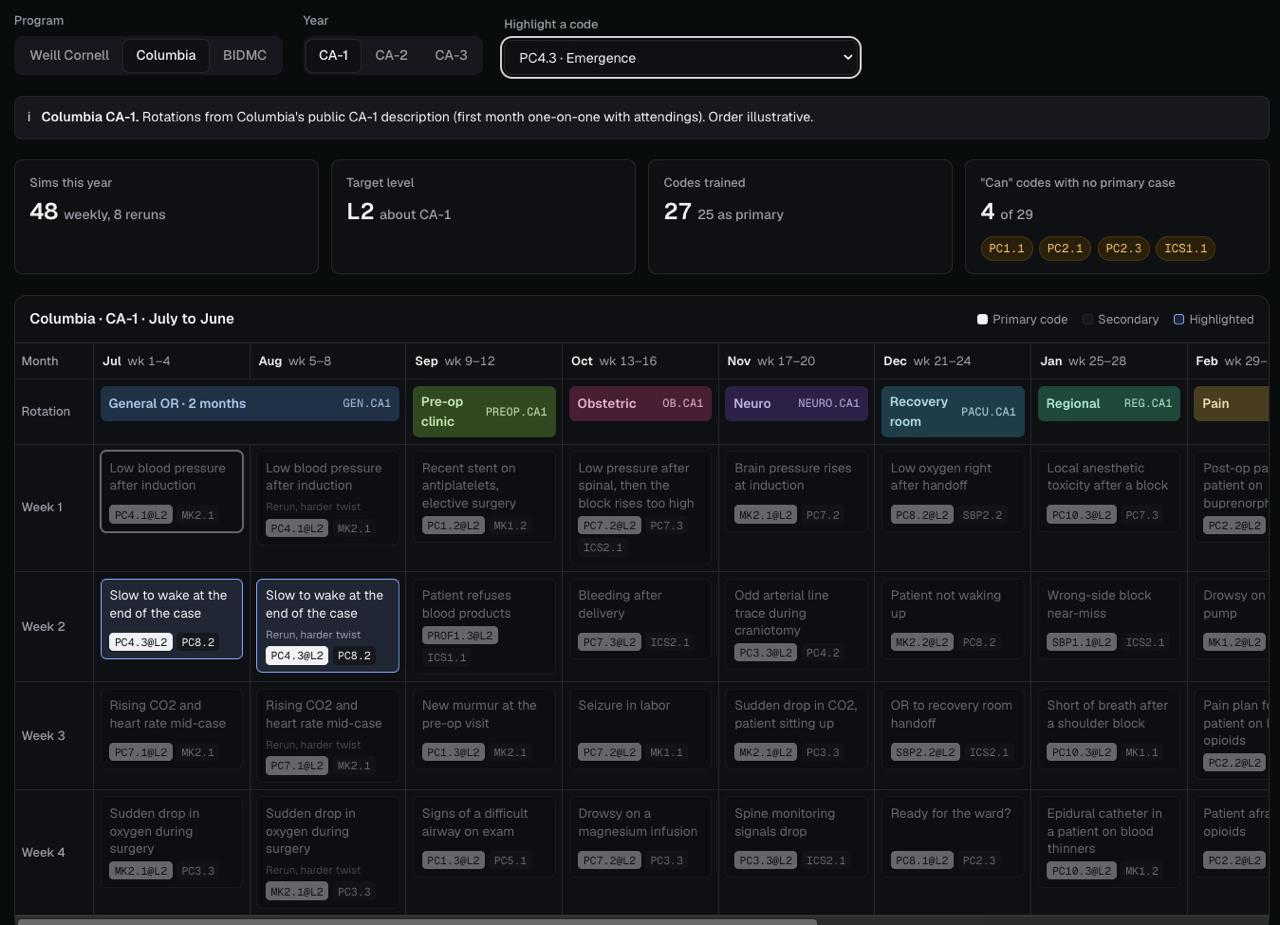
A starting point for faculty review—not a substitute for the program’s judgment.
How it works
Built around your program.
We draft your year
We start with your program’s public rotation schedule and propose cases for each training year.
Residents practice out loud
They work through cases on their own time and review a debrief afterwards.
You review the coverage
See the proposed mapping and discuss what to add, change, or practice again.
We’ll draft your program’s year. Tell us where we got it wrong.
Share your public rotation schedule, and we’ll prepare a starting point for an honest conversation about your curriculum.
See your program’s training year